Aerodoc’s executive team shares how it built the foundation to expand its services across priority markets in 2026.
2025 was far from an ordinary year for Aerodoc. It marked a turning point. The metaphor chosen by its CEO captures it well: it was a Formula 1 year. Not because of speed, but due to the technical rigor, precision in every adjustment, and the preparation required to launch a more competitive model in 2026. Teams, processes, and systems were rethought from end to end.
In this interview, Germán Muller, Founder – CEO at Aerodoc; Dan Zonnenschein, COO; and Carolina Muller, VP of Business Development, offer a detailed analysis of the challenges faced throughout 2025. They discuss key decisions to improve internal operations, the markets that drove the company’s growth, and how they achieved greater operational integration and efficiency.
What were Aerodoc’s most significant challenges in 2025?
German: For us, 2025 felt like a Formula 1 season, not because of the speed (though there was plenty of that), but because of the level of precision required to compete seriously. Aerodoc had been growing steadily, but we knew that to stay in the race, commercial traction wasn’t enough. It was time for a complete overhaul. One of the biggest challenges was restructuring our teams and redefining roles. We needed structure, clarity, and a deeper level of professionalization to scale without losing our core identity.

The response was methodical. We redesigned every area as if building a Formula 1 pit crew: each person with a defined role, every move carefully measured. We restructured the 35 key functions in our company and, most importantly, implemented monitoring systems and KPIs that provide us with real-time business visibility. We know what’s happening, when, and why. That’s how you compete at a higher level. The key? It wasn’t just about making changes, but about moving forward as one team, with focus and the shared belief that the future demands accuracy.
And in terms of processes?
German: Another major challenge was getting our “machines” ready. If people are the engine, processes are the engineering that makes it all work. Aerodoc couldn’t scale without a solid structure behind it. We needed clear pricing, tighter compliance, and high-precision operational control. That’s why we focused heavily on the foundation. We started with a key step: building the FOB valuation procedure, a fundamental tool for operating with consistency, especially in complex destinations. We also strengthened the technical and document verification process, which today is much more than an administrative task; it’s a quality checkpoint that helps us prevent mistakes and anticipate issues.
Dan: Exactly. All of this was critical, and I’d add that, alongside what German mentioned, perhaps the most impactful shift was the alignment across departments. Sales, Lead Converters, Marketing, and Operations began working from a shared roadmap. When that happens, the flow improves, and customers notice.
Was there a key moment in the year when everything was put to the test?
Dan: Absolutely. If the year felt like a Formula 1 season, the second half was our sprint race. Everything accelerated. We had been fine-tuning the car, focusing on processes, team, and structure, but we knew we’d eventually have to hit the track and see if it all held up. That moment came mid-year. The first meaningful results, the ones that really showed whether we were on the right path, didn’t appear until October. It wasn’t immediate. But that waiting period gave us something valuable: the chance to learn fast.
German: Exactly. Real-time experience helped us sharpen things. There are processes now being completed in half the time compared to early in the year. It was a sprint, yes, but one of those that permanently changes your pace. Today, we’re finishing the final tuning for what’s ahead. If 2025 was the test run, 2026 is the long race. And we want to be on the starting line in January with a truly competitive model.
Which markets stood out in the past year?
Caro: Aerodoc’s core continues to beat in sync with the tech and communications equipment sector, without question, our standout market in 2025. What’s most compelling isn’t just the volume, but the quality of the opportunity: we’re dealing with complex, high-value equipment that demands precision at every stage of the logistics process.
What’s driving this growth?
Caro: We were actually discussing this right before the interview, and all three of us agreed. First, there’s a wave of global tech upgrades underway. Many companies are refreshing their infrastructure, which opens the door for providers like us who specialize in the logistics of mission-critical equipment.
German: We’re also seeing more and more regional projects: companies that need to reach not just one country, but several at once. There’s been an apparent rise in multi-site, high-complexity operations. That’s where our document support, regulatory validation, and full coordination have made a real impact.
Caro: Exactly. And that puts multinational coordination to the test, something we’ve been refining at Aerodoc for years. What used to be a one-off request has become a chain deployment spanning three, five, or even ten countries simultaneously. These kinds of operations require a structure built to adapt quickly. That’s where we made a difference this year.
Dan: Another segment that showed strong growth this year was companies redirecting operations in response to tariff shifts. This trend is becoming increasingly common, especially in industries where margins are tight and every cost variable matters. In 2025, we saw many companies redesign their supply chains to adjust to new regulations, restrictions, or even sudden spikes in import costs. And rather than a challenge, that became an opportunity for us.
The key is that these companies weren’t just looking for a cheaper provider. They were looking for a partner capable of absorbing the technical demands of a shifting environment, someone who understands changing regulations, can respond quickly, and, most importantly, has the flexibility to design tailored logistics models.
Caro: Lastly, building on Dan’s point, I’d add that we saw strong growth in our importer of record services across new regions. Companies are increasingly aiming to simplify their international operations. They no longer want to manage multiple vendors or assume regulatory risks in countries where they don’t have a formal presence. What they want is a reliable, end-to-end solution, and that’s precisely what we deliver through our IOR and EOR services.
Which market is expected to stand out in 2026, and why?
German: All signs point to the Buy-Sell service becoming a significant growth driver for the business by mid-2026, as it simplifies the customer’s operation. Instead of managing several steps and parties, the customer delegates the entire process to Aerodoc. This reduces friction, shortens timelines, and lowers operational and legal exposure. Aerodoc already has the structure, processes, and compliance framework in place to operate under this model.
Dan: Another market that will continue to expand steadily in 2026 is IOR/EOR. We’re seeing growing demand for turnkey solutions, especially from customers operating across different countries and seeking more regionally integrated models. That push for simplification and broader coverage presents a strong opportunity for Aerodoc. We’re already working with that mindset and have the capacity to adapt to varying regulations while maintaining a centralized service approach.
Caro: I agree with Dan and German. I believe one of the most impactful shifts we’ll see in 2026 will be the development of our agents as true strategic partners. It’s about bringing them into the business conversation as real contributors. We’re building a partnership model that includes tangible incentives and a shared vision for growth. These agents generate leads, create opportunities, and bring volume into the ecosystem. That evolution in their role will be critical to expanding without losing reach or agility.
What was the most exciting or challenging part of your role this year?
German: As I said before, this year felt like living an entire Formula 1 season… behind the scenes. We had to rebuild the team, fine-tune every detail, and get ready for the launch ahead. It was intense, demanding, and at the same time, incredibly stimulating.
Caro: One of the most exciting parts was seeing the team gain absolute clarity. Everyone began to understand their role, each process found its place, and that brought both maturity and momentum. You could feel it in how we worked, how we communicated, and how quickly and decisively things were getting done.
Dan: For me, the most rewarding part came around October. That’s when we started to see the results of all the fine-tuning. It didn’t happen overnight, but when the first signs of progress appeared, they confirmed we were on the right path. That feeling, after so many months of work, was one of the year’s most fulfilling moments.
To close: What did 2025 represent for Aerodoc?
German: 2025 was the year we prepared to compete truly, a time of strategic and operational adjustments that were key to facing the future successfully. First, we rebuilt our teams. We knew that to scale, we needed clearer role definitions, a more structured approach, and a company capable of operating accurately across all areas.
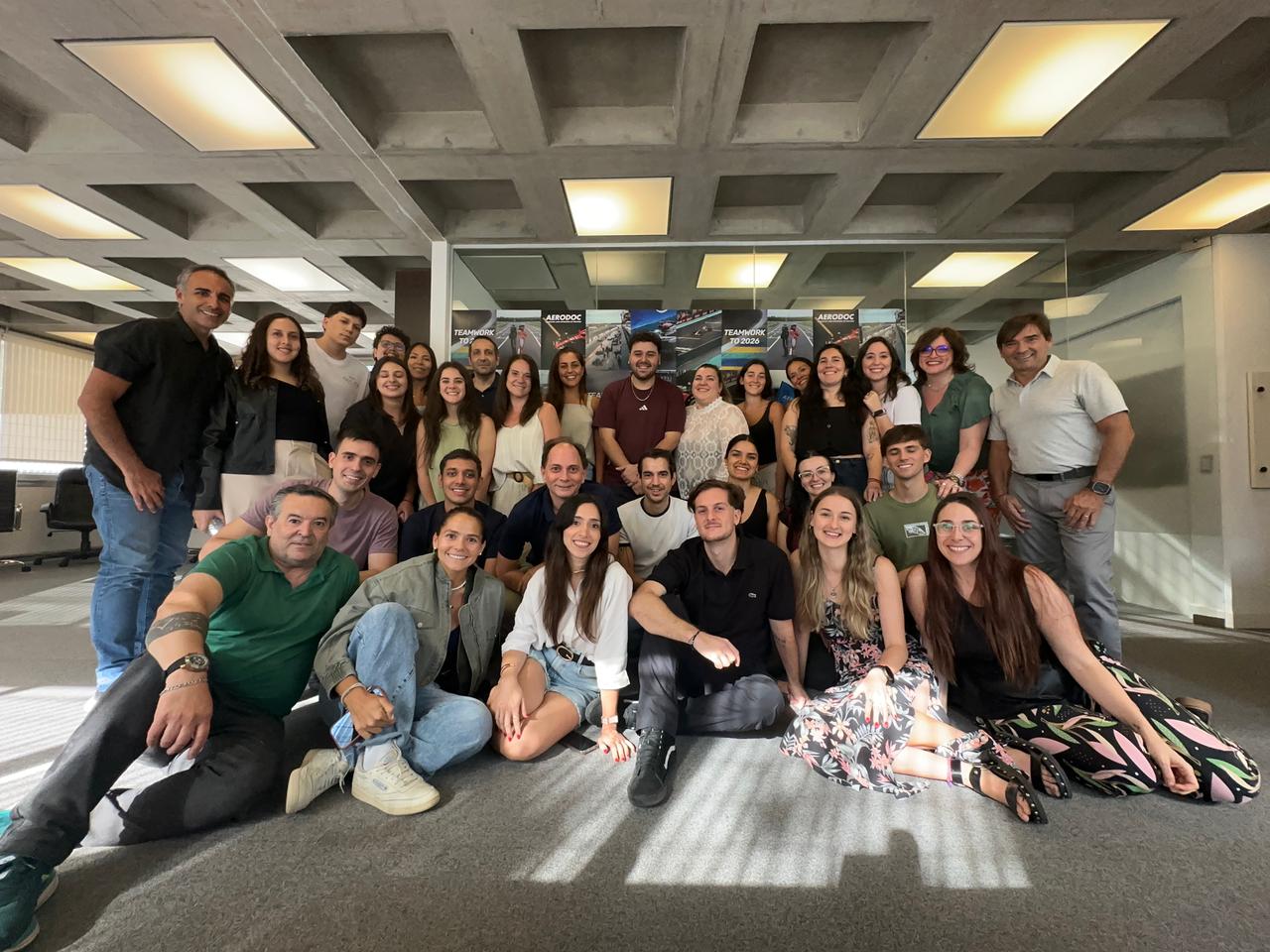
Then, we tuned the machines. That meant optimizing our processes, improving our systems, strengthening compliance, and tightening operational controls. All of this was necessary to make sure we had the infrastructure to meet future challenges.
By mid-year, we ran a sprint race, a moment when we were able to test everything we had put in place. It taught us valuable lessons that helped us improve even further.
Finally, we returned to the pit to make the necessary adjustments. Every detail that needed correction was reviewed and refined. Ongoing learning was key: it helped us fix what wasn’t working and reinforce what already was.
Q&A
- What key takeaways can other companies draw from Aerodoc’s internal restructuring process in 2025? Aerodoc’s experience highlights the importance of professionalizing roles, integrating cross-functional teams, and implementing real-time performance monitoring systems to enable scalable growth while preserving organizational identity.
- Why is the Buy-Sell model positioned to become a competitive advantage in the logistics sector by 2026? It streamlines the entire operational chain, reducing legal exposure and lead times. This model is particularly valuable for companies seeking efficiency and control in complex, regulated, and multi-site environments.
- How do evolving IOR/EOR services support the internationalization strategies of technology-driven companies? They allow businesses to expand into new markets without establishing a local legal entity, ensuring regulatory compliance and operational continuity through a seamless, turnkey logistics solution.
- What strategic role will local agents play in Aerodoc’s 2026 expansion model? They will act as commercial partners with aligned incentives, capable of generating qualified leads and enabling regional deployments, thereby enhancing reach without compromising agility or execution speed.