
Reverse Logistics
When hardware fails in the field, the replacement model you agreed to months earlier decides how long the site stays down. This guide compares standard RMA, advance exchange, and DOA claims so you can match each model to the right scenario.
Not every hardware return follows the same path. An advance exchange RMA ships the replacement before the defective unit comes back, a standard RMA waits for the return first, and a DOA claim covers units that never worked at all. Each model distributes downtime, cost exposure, and paperwork differently, and the differences sharpen the moment a border separates the user from the replacement depot. This article assumes you already know how the RMA process works end to end; the focus here is on choosing the replacement model that fits each failure. Aerodoc coordinates these replacement flows for technology companies as part of its RMA and reverse logistics services.
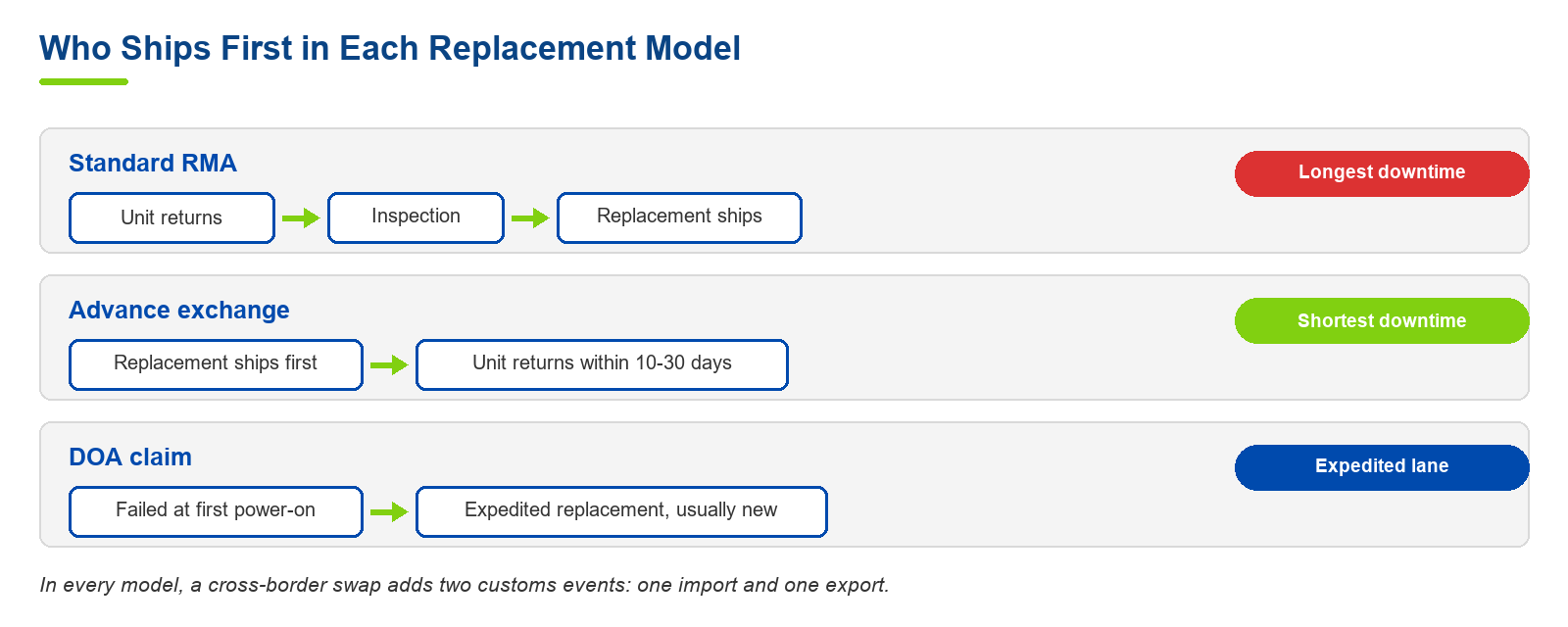
Three Ways a Defective Unit Gets Replaced
Every hardware replacement scenario resolves into one of three models. A standard RMA follows the return-then-replace sequence: the defective unit travels back, gets inspected, and only then does a replacement ship. An advance exchange, also called a cross-ship replacement or advance replacement, reverses the order: the replacement ships immediately and the defective unit returns afterward. A DOA replacement covers the special case of units that are defective out of the box and usually moves through an expedited lane.
Which model applies is rarely the user’s choice alone. It depends on the warranty terms the manufacturer publishes, the support contract in force, and the product category. All three sit inside the broader discipline of global warranty management, and all three behave differently once a border separates the user from the replacement stock.
Standard RMA Replaces After the Return
A standard RMA is the default path in most manufacturer warranties. The user reports the fault, receives an authorization number, ships the defective unit back, and waits. The vendor inspects the unit, confirms the fault is covered, and only then ships a replacement or a repaired unit.
The model is cheap to run and hard on uptime. The downtime is not one number but a chain of them: outbound transit, the receiving queue at the depot, technical inspection, replacement picking, and return transit. Domestically the chain commonly spans one to three weeks; across a border, customs clearance joins it twice. For redundant infrastructure or spare units that delay may be acceptable. For a revenue-generating site with no fallback it rarely is, which is why companies look for ways to simplify equipment returns and replacements before committing to the slowest model.
Standard RMA fits low-criticality hardware, users who hold their own spares, and products whose value does not justify shipping a replacement on trust.
Advance Exchange (Cross-Ship) Moves the Replacement First
An advance exchange RMA ships the replacement unit as soon as the claim is validated, before the defective unit comes back. The user receives the replacement, swaps it in the field, and sends the failed unit back with a prepaid label and the RMA number marked on the box. Three mechanics keep the model honest:
- Credit holds. Because the provider ships hardware against a promise, many require a credit-card hold, deposit, or purchase order covering the replacement’s value. The hold releases when the defective unit arrives back.
- Return deadlines. Cross-ship terms set a return window, commonly 10 to 30 days in industry practice, counted from the day the replacement ships or is delivered.
- Non-return fees. Miss the window and the hold converts into an invoice, often at list price, sometimes with a handling or non-return fee on top.
Advance exchange is the engine behind the replacement commitments many support contracts advertise. Industry SLA tiers such as next business day delivery or 24x7x4 response only work because a replacement can move before the return does. How those tiers are structured, and what they realistically cost, is covered in our guide to hardware replacement SLAs.
Setting up a cross-border replacement program? Call us: +1 (305) 640-0763
DOA (Dead on Arrival) Claims Cover Units That Never Worked
DOA describes a unit that is defective at first power-on or fails on first use, before it ever enters normal service. Because the product never worked, most vendors treat DOA replacement as a distinct claim type rather than an ordinary warranty case.
What qualifies is narrower than it sounds. A unit that runs for two weeks and then fails is an early-life failure, not DOA. Typical criteria include failure to power on, failure during initial configuration, or damage discovered on unboxing that traces to manufacturing rather than transit.
Claim windows are the critical variable, and they are set by each vendor, not by the logistics provider. Across the industry, published DOA windows range from as little as 24 hours after delivery to as long as 120 days, with 30 days a common midpoint for enterprise hardware. Those figures are industry norms, not commitments by any single provider: the only window that matters is the one printed in the warranty terms of the product in hand.
DOA claims usually get expedited handling for a simple reason: the customer paid for a product and received nothing usable, so a slow response costs more reputation than an in-service failure does. Many vendors ship a new rather than refurbished unit for validated DOA claims and move it ahead of standard queues. Protect the claim by reporting the failure immediately, photographing the unit and packaging, and recording serial numbers before anything ships back.
Will the Replacement Be New or Refurbished?
Most manufacturer warranty terms state that a replacement may be new, refurbished, or a functionally equivalent product of comparable performance. In practice that clause usually means refurbished. Certified refurbished units, tested and restored to factory specification, are the standard currency of warranty replacement pools, especially for advance replacement programs that must keep stock staged in volume.
Two industry norms are worth knowing. First, DOA claims are the usual exception: out-of-box failures are commonly replaced with new units. Second, the replacement does not restart the warranty; it typically inherits the remaining term of the original coverage, sometimes with a short minimum coverage period of its own.
For IT resellers and integrators there is an operational consequence: every swap changes a serial number in the field. Asset registers, warranty-date records, and support contracts all need to follow the new serial, which is why serialized tracking matters as much in the replacement flow as in the original deployment.
Standard RMA vs Advance Exchange vs DOA
The table below compares the three replacement models on the variables that drive the decision.
Two Shipments Means Customs Twice
Every replacement model doubles its customs workload the moment the user and the depot sit in different countries. A domestic swap is one shipment out and one shipment in. A cross-border swap is an import and an export, each with its own declaration, classification, and duty treatment, and in an advance exchange both move at once.
The inbound replacement needs an importer of record (IOR) in the destination country; the defective unit leaving needs an exporter of record (EOR). Duty relief exists but must be claimed, not assumed: returned-goods provisions such as US HTS 9801, temporary importation regimes (typically 3 to 12 months, duty-exempt only when the goods are re-exported, with terms that vary by country), and instruments like the ATA carnet for equipment that will come back. A replacement imported without the right framing pays full duty; a defective unit exported without matching paperwork can break the relief on the next entry.
Aerodoc acts as IOR and EOR in over 170 countries and prepares the customs documentation on both legs, so the replacement clears inbound while the defective unit clears outbound.
Staged Stock Makes Advance Exchange Possible at Scale
Advance exchange only works at scale if replacement stock already sits close to the users it protects. Cross-shipping from a single central depot re-imports the distance problem: the replacement may ship first yet still spend days in transit and customs. The structural fix is staged inventory in forward stocking locations, positioned in the markets where the installed base actually lives, so the cross-ship leg becomes a short domestic movement.
Staging stock is a warehousing discipline as much as a transport one. Replacement pools must be serialized, counted, secured, and rotated so the unit that ships is the right one, still inside its coverage window.
How Aerodoc approaches this
- RMA and reverse logistics is a named service in the portfolio: returned-unit registration, pickups, tracking, secure storage, customs documentation, and transportation to repair centers.
- Customers register each unit’s warranty expiration date, and FIFO logic deploys the oldest units first, so staged replacement stock does not age out of coverage.
- The AWMS warehouse system runs in SAP with FIFO control, monthly cyclic counts, and CCTV-secured facilities; the Miami hub is a bonded warehouse under C-TPAT and TSA-authorized.
- RMA requests and status updates run through the Aerodoc portal, with 24/7 inventory visualization.
- The warehousing and fulfillment network covers an active footprint in 22 countries, with IOR/EOR reach in over 170.
The result is not a headline promise but fast RMA turnaround built on stock that is already in the right country, registered and ready to move. In Aerodoc’s published case study with Crestron Electronics, lack of RMA support was one of the pain points before the engagement; the operation now runs at 99.9% inventory accuracy and 99.9% on-time delivery.
Choosing between standard RMA and advance exchange?
Aerodoc provides the staged replacement stock, warehousing, and IOR/EOR coverage that make either model work across borders, with rapid response assistance when a unit goes down.
Customizing solutions to be closer