
Warranty Logistics
A hardware warranty is only as strong as the logistics behind it. This is how tech companies honor manufacturer warranties for equipment installed in 170+ countries, even in markets where they have no legal entity.
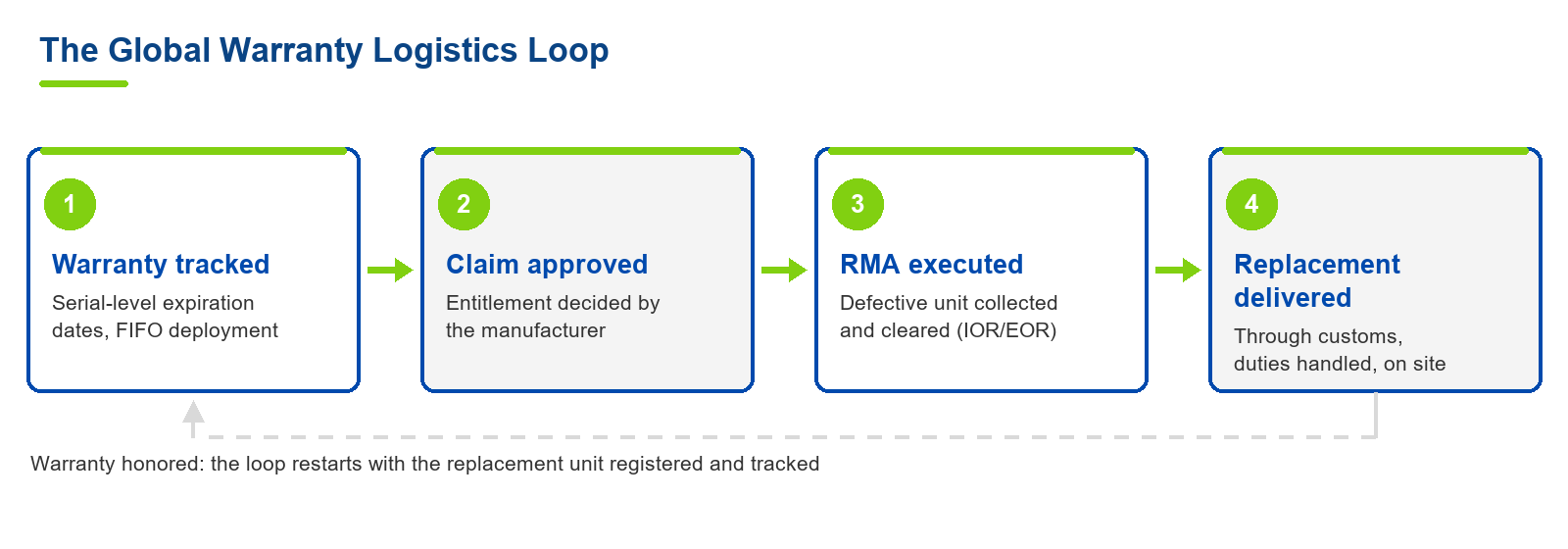
Global warranty management is the set of logistics practices that lets a technology company honor its hardware warranties wherever its equipment is installed: tracking warranty dates at serial-number level, deploying stock in the right order, executing cross-border returns, and delivering replacements through customs. The warranty itself always belongs to the manufacturer. What breaks down internationally is not the promise but the execution, and that is a logistics problem. Aerodoc, a Miami-based integrated logistics provider with more than 25 years serving IT, telecom, broadcasting, and satellite companies, supports exactly that execution layer with RMA support worldwide.
Why Hardware Warranties Break Down at Borders
A hardware warranty that works flawlessly in the country of purchase can fail completely one border away. Three obstacles cause most of the breakdown.
Geographic warranty limits. Many manufacturer warranties are written to be honored in the country or region where the unit was sold. A switch bought in the US and deployed in Chile may be fully covered on paper yet have no local service path at all.
No local entity. Importing a replacement unit or exporting a defective one usually requires a registered importer or exporter in that country. Tech companies rarely have subsidiaries in every market where their hardware ends up, so a legally valid claim can stall simply because nobody can clear customs.
Customs delays and duty exposure. Returned goods are a customs category of their own. Shipped without the right documentation, a defective unit coming home can be taxed as a brand-new import. Regimes like US HTS 9801 or ATA carnets can prevent that, as we explain in our guide to import duties on returned goods in RMA flows, but they must be planned before the unit ships, not after it is stuck.
What Global Warranty Management Actually Means (and What It Is Not)
Global warranty management means operating one coherent international warranty service across every country where your installed base lives: knowing which serial numbers are covered and until when, holding or reaching replacement stock, executing returns compliantly, and delivering working units through customs. Searchers sometimes call the same need international warranty service or warranty logistics; the underlying question is identical: “my customer’s device failed abroad, how do I honor the warranty?”
It is just as important to be clear about what it is not. It is not a warranty product, an extended warranty, or insurance, and it is not something a logistics provider issues. The manufacturer holds and defines the warranty; the logistics layer makes it deliverable. Aerodoc does not issue or extend warranties for anyone. What it provides is the operational machinery, from warranty-date tracking to efficient RMA execution in any country worldwide, that turns a written warranty into a replaced unit in a customer’s hands.
The Four Logistics Pillars of a Global Warranty Program
Strip away the vendor language and every working global warranty program stands on the same four pillars.
How Aerodoc approaches this
- Customers can register each unit’s warranty expiration date, and FIFO logic deploys the oldest units first so no serial number ages out unused.
- The AWMS warehouse system runs in SAP with FIFO control and monthly cyclic counts, in CCTV-secured facilities, with a bonded Miami warehouse under C-TPAT and TSA authorization.
- RMA requests are submitted and tracked through the Aerodoc portal, with 24/7 inventory visualization of every registered unit.
- Cross-border execution covers pickups, customs documentation, IOR/EOR, secure storage, and transportation to repair centers or final destinations.
Where the RMA Process Fits Inside a Warranty Program
Every warranty claim splits into two distinct decisions. The first is entitlement: is this serial number covered, by whom, and until when? That check is commercial, and it belongs to the manufacturer’s warranty terms. The second is operational: how does the defective unit physically travel back, and how does its replacement travel out? That second half is the Return Merchandise Authorization process, and we cover it step by step in that pillar guide, so this article will not repeat it.
What matters at the program level is that the two halves stay connected. An entitlement check that approves a claim the logistics network cannot execute produces a frustrated customer with a technically valid warranty. A global warranty program is what keeps approval and execution moving as one flow.
Mapping warranty coverage for an international installed base? Call us: +1 (305) 640-0763
Replacement Models and Speed: From Return-Then-Replace to Fast-Replacement SLAs
How fast a warranty replacement arrives depends on the replacement model the program uses. The industry works with three broad patterns. In return-then-replace, the defective unit travels back, gets inspected, and only then triggers a replacement: the cheapest model and the slowest, often weeks across borders. In advance exchange, the replacement ships as soon as the claim is approved and the defective unit returns in parallel. At the top sit SLA-backed tiers that hardware vendors sell around commitments like next-business-day delivery or 24x7x4 response, which only work when stock is already positioned near the customer. We break down what those tiers really involve in our guide to hardware replacement SLAs.
Logistics determines which models are even possible in a given country. Aerodoc’s role is rapid response assistance and fast RMA turnaround inside whatever model the manufacturer commits to. As a documented one-off, Aerodoc once executed an urgent UK-to-US shipment for a satellite provider in 72 hours; results like that are what a prepared network makes possible, not a standing commitment.
Coverage Math: 170+ Countries of Reach, 22 Countries of Warehousing
Two different numbers describe warranty coverage, and conflating them causes bad planning. The first is reach: the countries where defective units can be collected and replacements delivered legally. Aerodoc provides that through IOR/EOR services in more than 170 countries, acting as Importer or Exporter of Record where the client has no entity; the full list is on our global reach page. The second is footprint: the 22 countries where Aerodoc operates active warehousing and replacement stock can sit close to deployment sites.
Both numbers matter because they answer different warranty questions. Reach answers “can we honor the warranty there at all?” For one US IT reseller with over $7B in revenue, Aerodoc runs DDP deliveries with IOR coverage into 40+ countries: reach doing its job. Footprint answers “how fast?”: stock positioned in-country skips international transit and import clearance at claim time. Deciding where forward stock earns its cost is a discipline of its own, covered in our guide to forward stocking locations for RMA programs. Most programs blend both: warehousing where the installed base is dense, IOR/EOR reach everywhere else.
Proof in Practice: How Crestron Closed Its RMA Support Gap
Crestron Electronics, a global manufacturer of automation and AV control solutions, came to Aerodoc with a familiar warranty-program pain point: lack of RMA support in the international markets where its hardware was deployed. Equipment was installed and covered, but the return leg had no reliable operational owner.
With Aerodoc handling the logistics layer, the published results of the engagement speak the language every warranty program is measured in: 99.9% of orders processed on time, 99.9% delivered on time, 99.9% inventory accuracy, and 98.4% of orders without error. That is what honoring a warranty looks like when the metric is a delivered replacement, not a promise in a PDF.
Frequently Asked Questions
Is my hardware warranty valid internationally, in a different country than where it was bought?
Can you handle RMA and returns in countries where we have no legal entity?
Which countries can you collect defective units from and deliver replacements to?
Do you have depots or service coverage near our deployment sites?
How do you handle WEEE and e-waste rules when a unit is scrapped or recycled abroad?
Next Step: Make Your Warranty Deliverable Everywhere Your Hardware Lives
If your installed base has outgrown the countries where your warranty program actually works, the fix is not rewriting the warranty. It is building the logistics layer that honors it: serial-level warranty tracking, FIFO deployment, compliant returns, and replacement delivery through customs, in every market that matters to your customers.
Need to honor hardware warranties in countries where you have no entity?
Aerodoc supports manufacturer warranty programs with RMA execution, IOR/EOR in 170+ countries, warranty-date tracking, and FIFO-controlled warehousing in 22 countries.
Customizing solutions to be closer