
RMA Logistics
24x7x4, NBD, advance replacement: hardware SLA tiers sound precise until you read the fine print. This decoder explains what each tier really commits to, and what has to be true logistically before anyone can put a working replacement in your hands within 24 hours.
A hardware replacement SLA is the contractual clock that defines how quickly a failed device gets swapped for a working one. It is also one of the most misread documents in tech procurement. Buyers see “24x7x4” or “next business day replacement” and assume a working unit will reach any site they operate, anywhere in the world, within that window. The fine print usually promises something much narrower. This guide decodes the standard replacement tiers, shows what the clock actually measures, and walks through the logistics that must already be in place (in-country stock, pre-cleared customs, an importer of record) before any provider can hit an aggressive replacement target. It draws on what Aerodoc sees every day executing RMA logistics and global warranty management operations for tech companies, with IOR/EOR coverage in over 170 countries.
Why Published Replacement SLAs Disappoint
Most hardware replacement SLAs read like commitments and behave like intentions. The disappointment is built into the fine print, and buyers usually discover it during their first serious outage. Common clauses across the industry include:
- “Target, not guarantee.” Many contracts state the replacement window as an objective the vendor will use “commercially reasonable efforts” to meet, with no penalty if it slips.
- Response is not resolution. A 4-hour “response” can mean a technician acknowledges the ticket in 4 hours, not that a part arrives in 4 hours.
- Service-area maps. Premium tiers often apply only within a defined radius of the vendor’s stocking depots. Sites outside that radius drop to next business day, or to best effort.
- Carve-outs for borders. Shipping time, customs clearance, and import delays are routinely excluded from the clock, which quietly converts an international SLA into a domestic one.
- Cutoff times. A ticket validated at 3:01 PM often starts the clock the next business day.
None of this makes vendors dishonest. It reflects a logistical reality: the replacement lead time a vendor can honor depends on where its inventory physically sits, not on what the datasheet says.
Decoding 24x7x4, NBD, 8x5xNBD and Advance Replacement
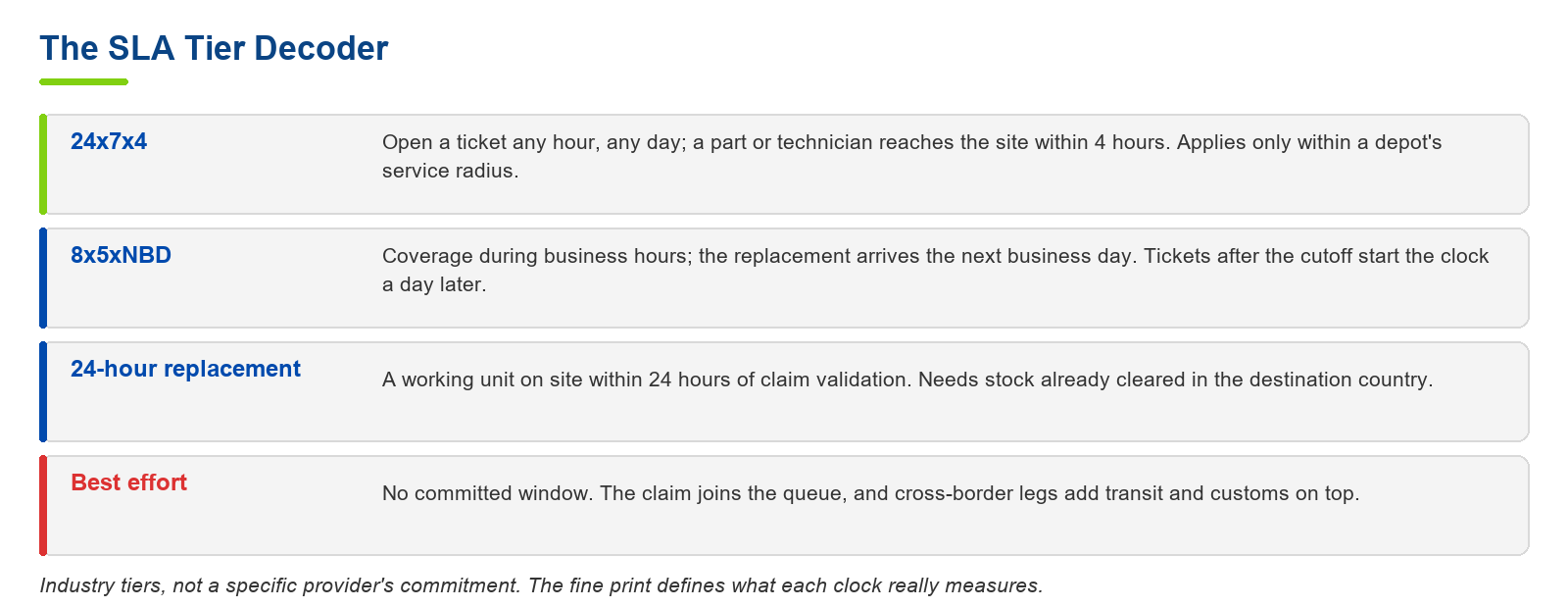
Each tier encodes three things: the coverage window (when you can open a ticket), the clock (how fast something happens), and the mechanism (what actually ships). Here is what the standard tiers mean in practice:
The pattern to notice: the more aggressive the tier, the more it depends on stock that is already local. 24x7x4 and 24-hour replacement are inventory placement commitments wearing a service contract as a disguise.
What the Clock Actually Measures (and What It Excludes)
The SLA clock does not start when your hardware fails. It starts when the vendor validates the ticket: serial number confirmed, entitlement checked, failure accepted as covered. If your team spends half a day troubleshooting before opening the case, that time is yours, not the vendor’s.
The clock also stops earlier than most buyers expect. Depending on the contract, it can stop when the replacement ships, when it reaches the destination country’s port of entry, or when it is delivered to a serviceable address. Three things almost never count against the vendor’s clock:
- Shipping to remote sites. Delivery beyond standard courier zones is excluded or surcharged.
- Customs clearance. For cross-border replacements, import processing is treated as outside the vendor’s control, even when it adds days to the real replacement lead time.
- The return leg. Collecting the defective unit runs through the standard RMA process on a separate, slower timeline. It does not delay your replacement, but missing the return deadline can trigger a charge for the advance unit.
One detail worth knowing for the return leg: defective US-origin units shipped back to the United States may re-enter duty-free as American Goods Returned under HTS heading 9801, provided the paperwork proves origin. Good customs documentation on the outbound shipment makes the reverse move cheaper and faster.
How a 24-Hour Replacement Unfolds Hour by Hour
Walk through everything that has to happen, in sequence, for any provider to deliver a replacement within 24 hours. Every row depends on a decision made months earlier, not on heroics made that day:
Read the third column again. Nothing in it can be improvised on the day of the failure. A 24-hour replacement is executed in 24 hours but built over months.
Evaluating replacement SLAs for an international deployment? Call us: +1 (305) 640-0763
Forward-Stocked Inventory Is the Prerequisite Nobody Mentions
Every aggressive replacement tier rests on the same unstated foundation: spare units warehoused inside the destination country before anything fails. The industry calls these depots forward stocking locations, and they are the difference between a replacement that travels 40 kilometers and one that waits in a customs queue.
Getting stock into position is itself a cross-border project. Someone has to act as the importer of record (IOR), classify the hardware, pay duties and taxes, handle import compliance, and register the units in a local warehouse. If your company has no legal entity in the destination country, that importer role has to be provided by a partner. Skipping this step does not make the requirement disappear; it just moves the customs delay to the worst possible moment, after the failure, when the clock is already running.
Advance Exchange Delivers the SLA
Forward stock answers “where is the unit?”. Advance exchange answers “in what order do things move?”. Under advance exchange, the replacement ships out first and the defective unit comes back afterward, decoupling your downtime from the slow return leg. That sequencing is what makes NBD advance replacement and 24-hour tiers deliverable at all: if the swap waited for the failed unit to arrive and be inspected, no clock under a week would survive. We break down the trade-offs, including credit holds and no-fault-found charges, in our comparison of advance exchange and standard returns.
How Aerodoc approaches this
- Aerodoc does not publish SLA tiers. It builds the logistics layer that lets manufacturers and resellers honor their own hardware replacement SLA commitments: rapid response assistance, warehousing across 22 countries, and IOR/EOR reach in over 170 countries.
- Customers register each unit’s warranty expiration date in the Aerodoc portal, and FIFO logic deploys the oldest units first, so the entitlement check in hour 0-2 runs against clean data.
- The AWMS warehouse system runs in SAP with FIFO control, monthly cyclic counts, and CCTV-secured facilities, with 24/7 inventory visualization through the portal.
- Crestron Electronics came to Aerodoc citing lack of RMA support as a core pain point. The published results of the engagement: 99.9% of orders on time, 99.9% delivered on time, 99.9% inventory accuracy, and 98.4% of orders without error.
The KPIs That Hold Vendors Accountable
A hardware replacement SLA you do not measure is a marketing asset, not an operational one. Three KPIs turn the contract into something enforceable:
- Replacement lead time. Measure it your way: from the moment your team detects the failure to the moment a working unit is installed, per country and per SKU. Compare that against the vendor’s clock, which starts at validation and often stops at shipment. The gap between the two numbers is where your downtime lives.
- Turnaround time (TAT). The full cycle for the defective unit: collection, transport, repair or scrap decision, and credit. Slow TAT ties up capital in advance-exchange holds and distorts spare-pool planning.
- Logistics SLA compliance rate. The percentage of cases where the committed window was actually met, reported by destination country. A vendor that reports one global average is hiding its weakest markets inside its strongest ones.
Put these metrics in quarterly reviews and tie them to remedies: service credits, tier upgrades, or added stocking points. Teams that instrument returns this way consistently find the biggest gains in process design rather than carrier speed, a theme we expand on in our guide to simplifying equipment returns and replacements.
Need the logistics behind your replacement commitments?
Aerodoc supports fast RMA turnaround with warehousing in 22 countries, customs documentation, rapid response assistance, and IOR/EOR services in over 170 countries.
Customizing solutions to be closer