Cross-Border RMA
A defective unit ships out, a repaired or replacement unit ships back, and customs can charge duty on both moves. Warranty returns are not automatically exempt: relief exists, but only if you claim it correctly.
Few line items surprise finance teams like import duties on returned goods. A device that already paid duty on its first entry can be taxed again when the repaired or replacement unit crosses the border, and a shipment everyone assumed was “free” can sit in customs while officers question the paperwork. This article explains how customs treats the shipments generated by the RMA process, which relief regimes fit warranty flows, and what documentation clears without drama. It is part of our series on global warranty management in tech logistics.
Why a Warranty Replacement Can Be Taxed Both Ways
The double-duty trap is when one warranty claim triggers two duty charges: the defective unit is taxed when it enters the repair country, and the repaired or replacement unit is taxed again when it re-enters the customer’s country. Customs systems are transaction based. Each border crossing is a new entry with its own declared value and duty liability, and no authority automatically connects a replacement import to duty paid months earlier on a unit that has since left the country.
The exposure doubles in advance exchange programs, where the replacement ships before the defective unit comes back: two high-value units cross borders in opposite directions at once, each generating its own dutiable entry unless a relief regime links them. On a busy warranty program, that duty leakage quietly becomes a significant share of the cost of honoring the manufacturer’s warranty.
Return Shipments Are Not Automatically Duty Free
So, are warranty returns duty free? Not by default. Customs assesses duty on the goods and their customs value, not on whether anyone paid for them. Being defective, under warranty, or shipped free of charge does not remove the liability. A specific legal provision, claimed proactively with evidence, does.
That evidence usually means proof of the original export or import, the entry number it cleared under, serial numbers tying the physical unit to that record, and a declared purpose for the movement. If a broker files a standard consumption entry because nobody flagged the shipment as a return, duty is collected in full, and recovering it afterward is slower than claiming relief up front. Import VAT and similar taxes follow the same logic: relief must be requested, not assumed.
Customs Regimes That Fit Warranty Flows
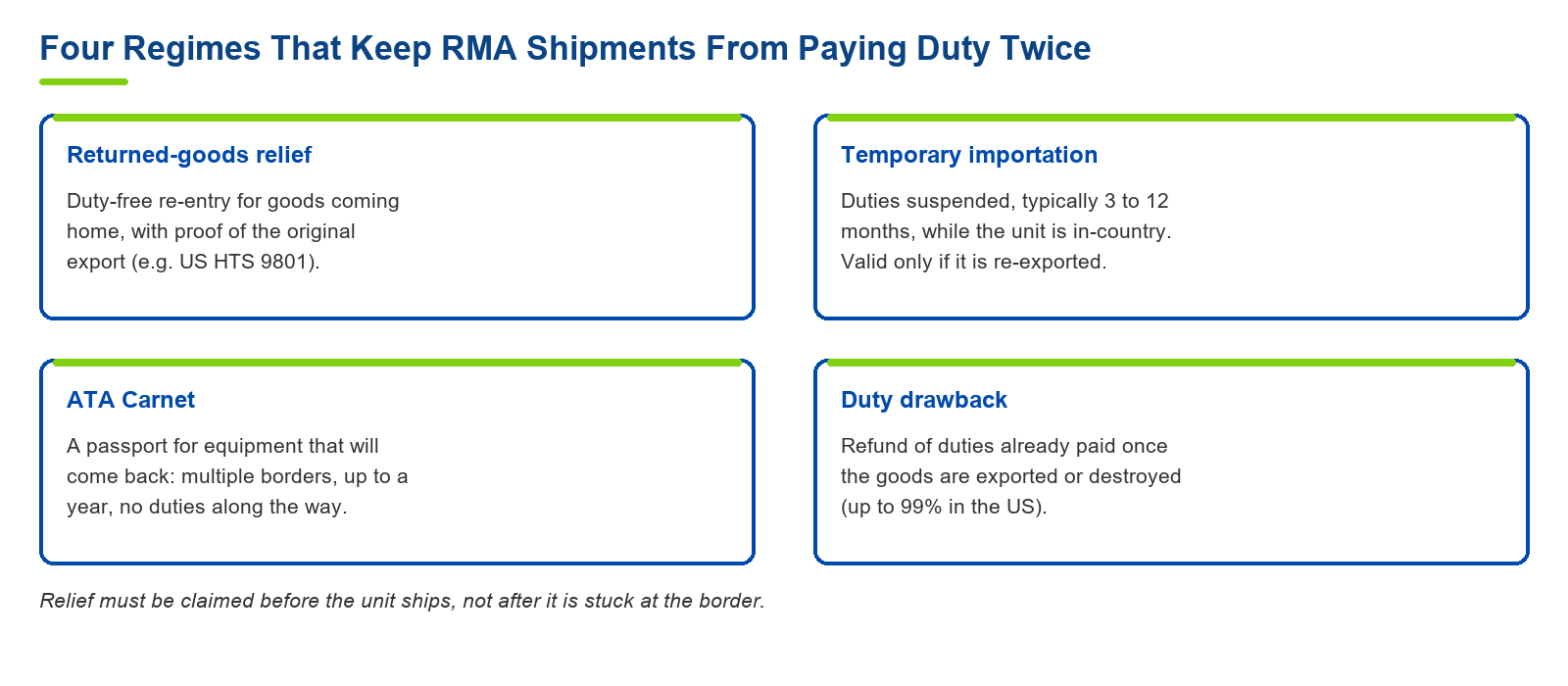
Three families of customs regimes map onto warranty logistics, and choosing between them before the unit ships is the highest-leverage decision in a cross-border return.
Returned-goods provisions let goods re-enter the customs territory they previously left without paying duty again, provided they come back essentially unchanged. In the United States, HTS heading 9801 covers qualifying goods returned without having been advanced in value or improved in condition abroad, commonly within a three-year window. Many other territories offer an equivalent returned goods relief with their own limits and proof requirements.
Temporary export for repair changes how the return is taxed when a defective unit leaves specifically to be repaired and re-imported. Depending on the country, the re-import can be relieved entirely or assessed only on the value the repair added. The catch: the declaration generally must happen before the unit leaves, and it is very difficult to claim after the fact.
Temporary importation suspends duties when equipment enters a country only to leave again, such as a loaner, test unit, or tooling sent alongside a repair. Relief typically runs 3 to 12 months, applies only when the goods are actually re-exported, and terms vary by country; the ATA carnet formalizes it for professional equipment in participating countries. We cover this regime in our guide to temporary imports as a strategy to reduce tax expenses.
Duty Drawback and Rejected-Merchandise Refunds
Duty drawback is the refund of duties previously paid on imported goods that are later exported or destroyed under customs supervision. Where the regimes above prevent a duty charge, drawback recovers one that already happened, which makes it the fallback when a defect is discovered after clearance.
The rejected-merchandise variant matters most for RMA flows. In the United States, goods that were defective at the time of import, or that do not conform to specifications or samples, can qualify for a refund of up to 99 percent of the duties paid, according to US Customs and Border Protection. Claims are documentation heavy: the original entry number, serial-level proof that the same goods left the country or were destroyed, and filing within the statutory deadline. Companies that link import entries to serials from day one file drawback routinely; those that do not usually learn the refund exists after the records needed to claim it are gone.
Facing duty charges on a warranty return flow? Call us: +1 (305) 640-0763
What Customs Expects From Free-of-Charge Replacements
A warranty replacement ships at no charge to the customer, but it never has a customs value of zero. Every import needs a declared value, and when there is no sale price, the value is built from the price of identical or similar goods or from the original transaction. Invoices marked “no commercial value” with no stated basis are one of the most reliable ways to get a tech shipment held for inspection.
The invoice should state that the goods are a warranty replacement supplied at no charge, declare a value “for customs purposes only” with its basis, and reference the RMA number and the original import entry. The unit is classified under its normal commodity HS code; special headings such as 9801 in the US are claimed alongside it, not instead of it. Aerodoc pairs this documentation work with customs clearance services for technology hardware so the declared story and the physical shipment always match.
Who Imports the Replacement When You Have No Local Entity
The importer of record is the party legally responsible for a customs entry: the declaration, the duties and taxes, and compliance with local regulations. Warranty replacements routinely need to clear in countries where the manufacturer or reseller has no legal entity, and the end customer rarely agrees to take on import liability for a box they did not buy.
A third-party Importer of Record (IOR) and Exporter of Record (EOR) service takes that responsibility so the replacement clears compliantly without a local subsidiary; Aerodoc provides this coverage in over 170 countries. The complementary strategy is to remove the border from the replacement leg entirely by pre-positioning stock in-region at forward stocking locations, so the swap the customer sees is a domestic delivery.
How Aerodoc approaches this
- IOR/EOR services in over 170 countries, so replacement units clear customs where the client has no legal entity.
- Customs documentation prepared per RMA shipment: valuation basis, serial numbers, RMA reference, and the link to the original entry.
- Returned units registered on arrival; clients can record each unit’s warranty expiration date, and FIFO logic deploys the oldest units first.
- Bonded warehouse in Miami under C-TPAT, TSA authorized, for staging defective returns and outbound replacements.
- RMA requests and status updates run through the Aerodoc portal, with 24/7 inventory visualization.
Paperwork That Clears vs Paperwork That Gets Held
Customs officers see thousands of “return” shipments and hold the ones whose paperwork does not tell a verifiable story. The difference between a routine clearance and a week in inspection usually comes down to a few habits.
✓ DO
- Declare accurate serial numbers that match the physical units, the RMA record, and the original entry.
- Reference the original import entry (entry number, date, declared value) so customs can link the export to the re-import.
- State the purpose explicitly: “returned for repair and re-export under RMA #___” or “warranty replacement, free of charge, value declared for customs purposes only.”
✗ DON’T
- Mark “no commercial value” without a stated valuation basis. Customs will assign a value for you, and hold the shipment while they do.
- Reuse the original commercial invoice from the first sale. It describes a transaction that is not happening.
- Ship before the customs regime is chosen. Temporary export for repair and most relief regimes must be declared at export, not claimed afterward.
Stop paying duty twice on warranty returns
Aerodoc structures cross-border RMA shipments with the right customs regime, IOR/EOR coverage in over 170 countries, and documentation that clears.
Customizing solutions to be closer