
Service Parts Logistics
Fast warranty replacement is decided before the failure ever happens. It depends on where the spare unit is sitting when the ticket opens.
A forward stocking location (FSL) is a warehouse positioned close to your installed base that holds tested, ready-to-ship spare units and service parts. When hardware fails in the field, the replacement ships from an in-country depot in hours instead of crossing a border. In this final article of our five-part RMA series, we look at the depot network behind fast warranty fulfillment, and how Aerodoc operates that network with warehousing across 22 countries.
Replacement Speed Is a Warehousing Problem
No courier can outrun geography. If the nearest good unit sits in a central depot on another continent, even premium express freight still faces transit time, export formalities at origin, and import clearance at destination. The paperwork can be flawless and the shipment still spends days in motion.
The variable that actually determines replacement time is stock position: the distance between the failed device and the closest tested spare. Once a unit is already in the destination country, cleared and stored locally, the replacement leg becomes a domestic delivery. That is why service parts logistics is designed around warehouse placement first and transportation second, and why the RMA process works best on top of a well-positioned depot network.
What Is a Forward Stocking Location (FSL)?
A forward stocking location is a warehouse placed near a concentration of installed equipment, holding spare units and service parts that are already imported, inspected, and ready to deploy. You will also hear it called a spare parts depot, a field stocking location, or an in-country spares pool. The names vary; the function does not: put good stock close to the point of failure before the failure happens.
An FSL is not a copy of your main distribution center. It carries a narrow, high-rotation selection: the models with the largest installed base, the parts that fail most often, and the units tied to active support contracts, sized against the installed base in that country rather than sales forecasts.
FSL vs Central Depot vs On-Site Spares
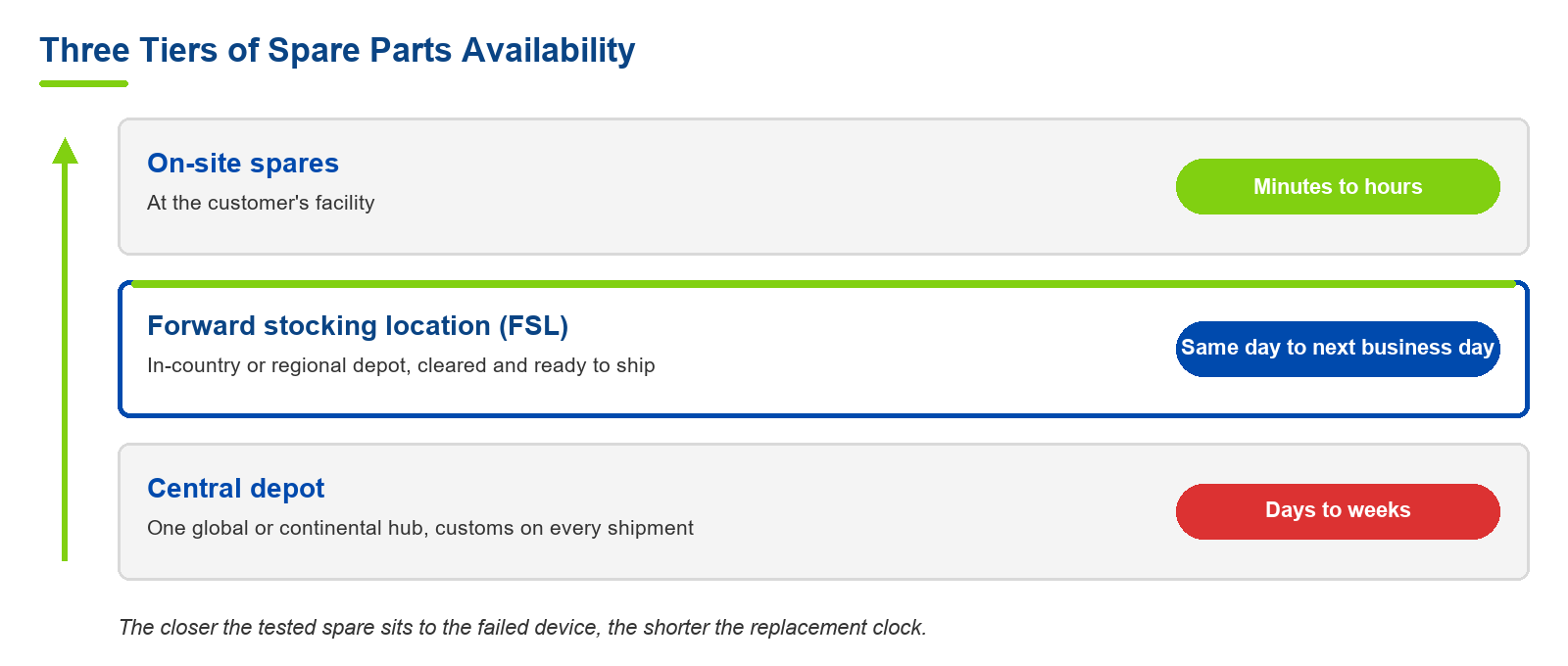
Most tech hardware programs combine three stocking tiers, each trading cost against proximity.
The replacement tiers customers ask for across the industry, such as next business day or 4-hour response, map directly onto these layers: they are only realistic where a forward stocking location or on-site spares already exist. The windows above describe how the industry structures these tiers, not a specific provider’s commitment.
Inventory Disciplines That Protect Warranty Value
A spare parts depot full of expired or untraceable stock is worse than no depot at all. Manufacturers hold the warranties; the depot’s job is to make sure every unit that ships out is still inside its coverage window and fully documented. Four disciplines carry that weight:
- FIFO deployment: the oldest units ship first, so no unit ages quietly on a shelf until its warranty lapses.
- Serial-level tracking: every unit is registered by serial number at receipt, so the depot can trace which device went to which customer and when.
- Warranty-date registration: each unit’s warranty expiration date is recorded at intake, flagging stock near the end of coverage before it becomes dead weight.
- Cycle counts: recurring partial counts reconcile physical stock against the system, catching discrepancies long before an annual inventory would.
How Aerodoc approaches this
- Aerodoc’s warehouse management system (AWMS) runs in SAP with FIFO control and monthly cyclic counts, in CCTV-secured facilities.
- Customers can register each unit’s warranty expiration date, and FIFO logic deploys the oldest units first so stock ships while coverage is still active.
- The Aerodoc portal gives customers 24/7 inventory visualization, plus RMA request submission and status updates in one place.
- Discipline shows in the numbers: in the published Crestron Electronics case study, where lack of RMA support was a pre-Aerodoc pain point, the operation runs at 99.9% inventory accuracy and 99.9% on-time delivery.
Evaluating in-country spares for your installed base? Call us: +1 (305) 640-0763
RMA Without vs With Forward Stocking
The clearest way to see what an FSL changes is to follow one failed unit through both models.
RMA without forward stocking
- The unit ships abroad: the failed device travels to a central depot in another country, and its replacement travels back.
- Customs twice: the return leg clears export and import, then the replacement leg does it all again in reverse.
- Duty exposure on both legs: without the right regime, import duties on returned goods can be charged on units you already own.
- Weeks of downtime: transit, clearance, and repair queues stack up while the end customer waits.
Result: a fast replacement commitment is physically impossible to honor.
RMA with a forward stocking location
- Same-day pick: the replacement is picked from the in-country spare parts depot and delivered domestically.
- No border for the replacement: the unit was imported, cleared, and tested before the failure occurred.
- Single customs event: only the defective unit crosses a border, on the return leg, under a planned regime.
- Downtime in hours or days: the end customer is back online while the defective unit is still in transit.
Result: replacement commitments become feasible and repeatable.
A Bonded Miami Hub Feeding In-Country Depots
A network of forward stocking locations needs a hub that feeds it. In Aerodoc’s model, the hub is a bonded warehouse in Miami, certified under C-TPAT and TSA-authorized. Stock consolidates there, and replenishment flows out to in-country warehousing and fulfillment operations across 22 countries, each spoke sitting close to a concentration of installed equipment.
One distinction matters when planning coverage: the 22 countries are Aerodoc’s active warehousing footprint, where physical depots hold stock today. IOR/EOR reach extends to more than 170 countries, so efficient RMA support continues even where you do not stage inventory: returned-unit registration, pickups, customs documentation, secure storage, and transportation to repair centers, coordinated case by case. Stage stock where the installed base justifies it; rely on the broader network everywhere else.
In-Country Stock vs Cross-Border Return-and-Repair
Forward stocking is not free, so the question is where it pays. Holding in-country spares means carrying inventory capital plus the operating fees a reverse logistics provider charges: receiving and inspection per unit, storage billed by pallet or position, pick-and-pack handling on the way out, and project work such as testing or refurbishment. The fee structure is standard across third-party logistics providers serving tech hardware; the amounts depend on volume, unit size, and market.
Against that, price the cross-border alternative honestly: freight in both directions, brokerage on each clearance, duties on any leg without a relief regime, and the downtime your end customer absorbs while the unit travels. Temporary importation can suspend duties, typically for 3 to 12 months and only when the unit is re-exported, with terms that vary by country, but it adds paperwork and deadlines to every event. For high-value units with an active installed base, staging stock in-country usually wins. For low-value or end-of-life units, local repair or scrapping often beats shipping in either direction.
How FSLs Power Replacement SLAs and the Wider Warranty Program
Everything this series has covered converges at the depot. Hardware replacement SLAs are contractual promises, and the industry tiers behind them (next business day, 4-hour response, advance exchange) all assume a tested spare within reach of the customer. The forward stocking location is the physical layer that makes the promise honest. At the program level, managing warranties across global markets rests on the same infrastructure: manufacturers hold the warranties, and the depot network provides the logistics to honor them, from warranty-date tracking and FIFO deployment through RMA execution in each country.
Design the network around your installed base, run it with strict inventory discipline, and the rest of the warranty operation, from customs strategy to SLA feasibility, gets simpler.
Ready to put spare parts within reach of your customers?
Aerodoc runs bonded and in-country warehousing across 22 countries, with IOR/EOR reach in more than 170 countries, backed by 25+ years serving IT, telecom, broadcasting, and satellite companies.
Customizing solutions to be closer